CODE OF CONDUCT
FOR
PLANETCAST
&
(Its Subsidiary Companies)
-
These Code of Conduct will come into force from 1.4.2005 and shall apply to all the employees of Planetcast Media Services Limited and its subsidiary companies.
-
The Company may formulate such rules & regulations and post such notices as it may from time to time consider necessary for the running of its establishments in confirmity with these Code of Conduct. These rules, regulation or notices may apply to the whole and every employee shall obey the Rules & Regulation come within the scope of this Code of Conduct.
-
Notices required to be displayed under these code of conduct shall be circulated in English language through Email / Notice Board / Company website.
-
These Code of Conduct may be amended or modified from time to time according to the need / requirement.
-
- “Attendance” means the presence of the employee concerned at the place or the places where by the terms of his employment, he/she is required to report for work and to get his/her attendance marked.
- “Company” means Planetcast Media Services Limited and its subsidiary companies.
- “Employee” means any person employed by the Company.
- “Management” means the Executive Directors / Whole Time Directors / Board of Directors or any other Officer duly authorized to act on their behalf or to whom any of their powers is delegated.
- “Notice” means a notice in writing required to be circulated through email / pasted on the Notice Board for the purpose of these Code of Conduct.
-
- Permanent
- Probationary
A permanent employee is one who is employed on a job of permanent nature for a period of atleast 6 months or who has satisfactorily put in 6 months continuous service in a permanent post as a probationer.
A probationer means a person who is provisionally employed to fill a vacancy in a permanent post for a period not exceeding 6 months and who has not completed his probationary period provided that the period or probation may be extended by the Management beyond the original period.
-
Company is providing the facility of Medical Examination to all its employees as per their grade.
-
Every employee will be issued an Identity Card bearing relevant particulars concerning himself pertaining to his employment.
Every employee who has been issued Identity Card must display the same while on duty or in office premises and shall produce the same on demand to any officer/employee so authorized by the competent authority.
An employee who loses his identity card must report the loss immediately to the Administration Department.
The initial issue of the Identity Card shall be free of charge. If the identity card is lost by the employee, he shall be liable to pay to the company a sum of Rs.40/- for the issue of the duplicate card. In case, identity card becomes indecipherable due to normal wear & tear, the Administration Department will replace it without any charge.
-
All employees working in the organization shall enter and leave the workplace only through the authorized places / routes / gates. Every employee may also be subject to search before entering or leaving the workplace by an employee / security guard of the company authorized for this purpose by the competent authority.
Female employee may be searched by a female employee / female security guard authorized by the competent authority for this purpose.
-
As per Company Policy / work requirement.
-
As per Company Policy / work requirement.
-
As per Company Policy & appointment terms.
-
As per Company Policy.
-
As per Company Policy.
-
- Casual Leave
- Sick Leave
- Earned Leave
- Maternity Leave
-
As per Company Policy work requirement / duty roasters.
-
No employee shall take any paper, books, drawings, photographs, instruments, apparatus, documents in any form (soft copy / hard copy) or any other property belongs to the company out of the office premises except with the written permission of his immediate reporting manager / Administration Department nor shall be in any way pass or cause to be passed or disclose or cause to be disclosed any information or matter concerning execution of work, trade secrets and confidential documents of the establishment to any unauthorized person, company or corporation without the written permission of the Company.
-
Employees may be transferred due to the exigencies of the work from one station to another, from one location to another or from one department to another within the company or its subsidiaries provided that the grade, pay and other conditions of services including continuity of the services of the employer are not adversely affected by such transfer.
-
As per appointment terms.
-
Company has been providing the Group Mediclaim Insurance to all its employees as per their grade, Medical Aid is being covered in all such cases.
-
Without prejudice, to the general meaning of the term, 'misconduct', it shall be deemed to include the following:
- Habitual late attendance or willful or habitual absence from duty without sufficient cause.
- Habitual negligence or neglect of duty malingering slowing down of work or inciting others to do so.
- Gambling, drunkenness, intoxication, riotous, or disorderly behaviour, threatening, or coercing other employees or interference with work of other employee.
- Collection of, or canvassing for, moneys within the precincts of the company without permission of the Management.
- Deliberately spreading false information or rumours with a view to bringing about disruption in the normal work of the company.
- Unauthorized use or occupation of the Company's Guest House.
- Habitual indiscipline, or willful insubordination or disobedience of any lawful or reasonable order of higher authority.
- Theft, fraud or dishonesty in connection with Company's business or property.
- Giving false information regarding one's particulars for the purpose of employment or concealing any facts about previous employment, age or any other particulars required by the company.
- Taking or giving, offering or asking for bribes or any illegal gratification whatsoever or indulging in corrupt practices.
- Assaulting or intimidating employee of the company in the company's work premises or estates.
- Bringing or attempting to bring any political or other outside influence to bear upon any superior authority in respect to matters pertaining to services under the company.
- Conviction by a court of law for any criminal offence involving moral turpitude.
- Breach of Trust
-
Minor Penalty: where an employee is charged with a misconduct, which may lead to imposition of a minor penalty, he shall be informed in writing of the allegations made against him and shall be given an opportunity to explain his conduct within 48 hours. His explanation, if any, shall be considered before imposing a minor penalty by the Administration Department. Provided, however, that where a workman denies the charges alleged against him, no punishment shall be imposed upon unless a domestic enquiry has been conducted.
Major Penalty: where an employee is charged with a misconduct, which may lead to the imposition of a major penalty, he shall be informed in writing of the allegations against him and shall be given an opportunity to explain his conduct within a period of 7 days. On receipt of a employee's explanation if it is decided to proceed further an enquiry shall be held. Such enquiry will be conducted by an officer other than the officer who has either reported the alleged misconduct or issued the charge-sheet. Upon enquiry, the employee concerned shall be afforded reasonable opportunity of explaining and defending his conduct with the assistance of the fellow employee. Where such enquiry relates to the alleged misconduct of several employees, the enquiry may be held for all the employees together.
Where a disciplinary proceedings against an employee is contemplated or is pending or where criminal proceedings against him in respect of any offence are under investigation or trial and the employer is satisfied that it is necessary or desirable to place an employee under suspension, he may, by an order in writing, suspend him with effect from such date as may be specified in the order. A statement setting out in detail the reason for such suspension shall be supplied to the workmen within a week from the date of suspension.
During the period of his suspension, an employee shall not enter the office premises except with the permission of the Management, nor shall he leave station without the permission of the Management.
-
Where an employee has been convicted for a criminal offence in a Court of Law or where the Management is satisfied, of reasons to be recorded in writing, that it is inexpedient or against the interest of security to continue to employ him, an employee may be removed or discharged from services without following the procedure laid down in Code of Conduct No. 22. (mentioned above)
-
The following penalties may, for good and sufficient reasons and as hereinafter provided, be imposed on a workman for misconduct, viz -
Minor Penalties:-
- Censure
- Fine
- Suspension without salary as substantive punishment for not more than ten days at a time.
Major Penalties:-
- Stoppage of increment / annual appraisal.
- Reduction to a lower grade or post or stage in a time scale.
- Dismissal or discharge from services.
-
As per Appointment terms.
-
Every employee is entitled to a service certificate, specifying the nature of work, designation and the period of employment (including the days, months & years) at the time of discharge, termination or resignation from the services and the management shall supply the same within 30 days of the receipt of application from the concerned ex-employee.
-
As per appointment terms.
-
A copy of these Code of Conduct may be circulated through company's email to all its employees or make available at the company's website.
-
PLANETCAST MEDIA SERVICES LIMITED ANTI-CORRUPTION, ANTI-MONEY LAUNDERING AND ECONOMIC SANCTIONS COMPLIANCE POLICY
For more Information about the Compliance Policy click here.
=============================================================================================================
FRAUD RISK POLICY
OVERVIEW :
Planetcast Media Services Limited (‘PMSL’ or ‘the Company’) Fraud Risk Policy outlines the principles and framework implemented to ensure PMSL is able to minimise the risk of fraud occurring across the organisation. As a market operator and provider of media related services PMSL is subject to the risk of fraud occurring, either internally or involving external parties, and requires strong fraud prevention and detection procedures.
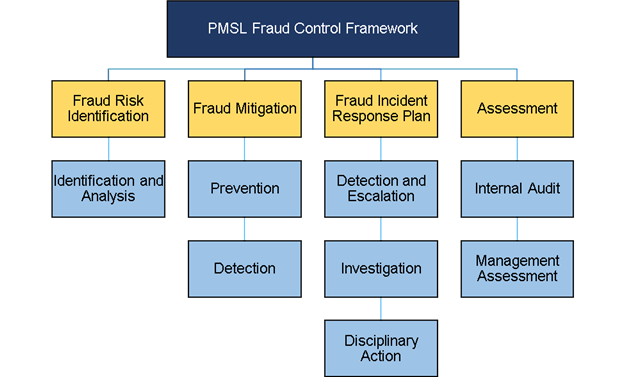
The PMSL Fraud Control Framework consists of the following elements:
Fraud Risk Identification : The identification and assessment of specific fraud risks which are applicable to various business units within PMSL.
Fraud Mitigation : Both preventative and detective fraud control measures are implemented to reduce the risk of fraud occurrence and to allow for prompt identification of incidents if they occur. Fraud awareness training is provided to PMSL staff focussing on task diligence and concern escalation with references to the PMSL Code of Conduct and PMSL Whistle blower Policy.
Fraud Incident Response : Includes investigation responsibilities, remedies and reporting requirements for fraud incidents that do occur. It is envisaged that initial investigations into alleged or potential frauds would be conducted by a Fraud Response Team.
Fraud Assessment : An annual fraud assessment is conducted by
Internal Auditor and Management to identify and document key fraud risks and associated mitigations. In
addition, fraud is considered in the majority of the audits performed by Internal Audit. Business units
self-assess their fraud risks as part of their risk profiling activities.
Overall, the PMSL Fraud
Control Framework is a combination of embedded fraud controls and general staff awareness supported by
regular business unit and independent fraud risk assessment. On-going execution of this framework is
expected to minimise the occurrence and impacts of fraud across PMSL.
INTRODUCTION :
Fraud involves dishonestly obtaining an advantage through the intentional misrepresentation, deception, or concealment of information. General examples of fraud potentially manifesting at PMSL, whether from within the organisation itself or from an external source, include:
- financial theft or misappropriation of cash or securities
- Improper or unauthorised expenditure
- Unauthorised or inappropriate access to or release of information
- Forgery and alteration of documents
- Inappropriate use of insider knowledge
- Misappropriation or misallocation of organisational resources, such as computer or telecoms equipment
- Inappropriate or favourable treatment of associated parties for personal benefit
- Falsification of records and data, such as payment or payroll records, and fraudulent financial reporting.
Some of the factors identified that can increase the risk of fraud in the PMSL include:
- Busy schedule of business and system change activities, including changes to processes and internal control
- Intelligent, sophisticated employees and customers
- Complex systems and products
- On-going business expansion and increasing number of initiatives new to PMSL
- Adoption of sales based reward programmes
- Competition across wider span of PMSL’s businesses
- Manual performance of certain key procedures and controls
- Concentrated business and system knowledge, and
- Potential for collusion on the part of employees, customers or suppliers.
OBJECTIVES AND PRINCIPLES :
Objectives
The objectives of the PMSL Fraud Control Framework are to:
- identify and assess potential sources of fraud within the organisation
- design effective mitigating controls to reduce the opportunity to commit fraud and detect its occurrence should the preventative controls not be designed or operating effectively
- enable effective responses and investigations into fraud incidents to reduce their impact and potential loss amounts, and
- Provide a mechanism for accurate reporting of the fraud control environment and timely reporting of fraud incidents.
PRINCIPLES :
The key principles governing the PMSL Fraud Control Framework and application are:
- PMSL has zero tolerance for fraudulent or dishonest activity within the organisation
- Responses to fraud incidents need to be independent, timely and comprehensive
- Business units are required to understand and mitigate their fraud risks; and
- Staff are required to contribute to the minimisation of fraud occurrence and impacts.
SCOPE :
The PMSL Fraud Control Framework applies to any activities potentially subject to fraud, or suspected fraud, involving employees, consultants, vendors or contractors and/ or any other parties having a corporate relationship with PMSL in any of its locations
ROLES AND RESPONSIBILITIES :
Audit Committee :
Audit Committee is responsible to overview the fraud investigation, remediation and disciplinary action.
PMSL Staff:
PMSL staff are required to:
- perform their roles and tasks ethically and diligently;
- be vigilant and report any instances of suspected fraud promptly; and
- actively participate in PMSL fraud awareness training as required.
POLICY STATEMENTS :
Identification and analysis
Fraud risks can arise from a number of areas within the PMSL. Examples include:
- inappropriate release or theft of sensitive information as a result of poor information security;
- Unlawful manipulation of operating rules or bias in rule making / granting of rule waivers to benefit a certain party unfairly; and
- Unlawful manipulation of client fee or rebate thresholds for benefit or kickback.
MITIGATING FRAUD CONTROLS :
Control procedures to mitigate the risk of fraud can either be preventative or detective, or both, in nature. Examples of each include:
Preventative :
- Workplace policies and culture promoting and encouraging ethical behaviour
- New employees acknowledge policies upon commencement
- Regular policy updates and communication to staff
- Online fraud awareness training
- High risk employees subject to annual acknowledgement of some policie
- Authorisation, review and reconciliation controls with core processes
- Segregation of duties enforced (including some enforced by systems and automated workflow)
- Periodic review of fraud risks and scenarios
- Pre-employment screening and background checks
- System access controls
- centralised operations
- Automated daily transaction processing
- Physical security controls
Detective :
- escalation and provision of whistleblowing through letter, internal mail or anonymous mail
- reviews of exception reports and reconciliations and other management reporting
- exception reporting for some systems
- assurance and compliance functions
These controls are either purposely implemented to prevent fraud or by their nature indirectly reduce the risk of fraud. The overall control environment and staff fraud awareness also contribute to fraud reduction:
-
Primary Fraud Controls :
-
Secondary Fraud Controls :
-
Overall Control Environment :
- Management-defined policies and procedures (e.g. policies on ethics and conduct policies (including code of conduct, whistle blower policy, dealing rules for employees and directors), employee assistance, diversity and equal opportunity, WHS, leave and working conditions)
- Culture of recognition and compliance with the organisational responsibilities in regard to regulatory, environmental and social issues
- Performance, remuneration and reward strategies and commitment to promote competence, compliance and development of staff
- Independent board and requisite oversight committee
- Organisational structure that promotes independent internal audit, risk management and compliance functions; and
- Management focus on operational issues and willingness to discuss and address potential control weaknesses.
-
Fraud Awareness :
These are controls which are specifically designed to reduce the risk of fraud occurring and usually operate ‘nearby’ to physical assets. Segregation of duties between specific functions, the requirement for dual transaction authorising signatories and input/checker transaction approval procedures are examples of primary fraud controls.
These are controls which have primary objectives of accuracy, validity and completeness, but their presence acts to deter or detect fraud. Examples include bank and system reconciliations, and supervisory reviews.
Commonly referred to as the ‘tone at the top’, the overall control environment sets the tone of the organisation and manifests itself in the PMSL organisational culture and the ethics, integrity and competence of the people within the group. It is influenced by management’s operating style and philosophy, the way management assigns responsibility and authority, the way the organisation structures and develops its people and the attention and direction provided by the Board. The control environment is represented at the PMSL through a number of tangible and intangible mechanisms, including:
A common way in which internal fraud is detected is by observation and reporting by workplace colleagues of the perpetrator(s). Similarly, a likely way for externally instigated fraud to be detected is by an employee of the victim organisation. It is therefore important that PMSL staff have a general awareness of fraud and the appropriate response to be adopted if this type of activity is detected or suspected. Accordingly, PMSL staff are provided general fraud awareness training.
Complementary to this, PMSL senior management play an important role in demonstrating the organisation’s commitment to fraud control, including supporting a culture of fraud awareness and vigilance amongst staf
Fraud controls are required to be effectively designed and implemented; however, it should be noted that any system of fraud risk management and internal control is designed to provide reasonable assurance that fraud will not eventuate. Although clearly desired, it does not guarantee that fraud will not occur; rather, its objective is to reduce the risk of fraud to an acceptable level.
FRAUD INCIDENT RESPONSE :
Detection and Escalation :
A key aim of the framework is the early detection and escalation of fraud incidents within the organisation. A culture of fraud awareness and openness in relation to fraud reporting should be encouraged. Clear channels of escalation through senior management are defined and, if applicable, the staff member(s) reporting the incident will be afforded protection as outlined in the PMSL Whistle blower Policy.
Investigation :
Upon notification of a fraud event, Audit Committee will form a Fraud Response Team (FRT) with at least 3 members including Company Secretary. Actions of the FRT are to:
- Identify and assess required team members
- Determine requirements to notify law enforcement or regulatory agencies of events
- Determine whether to seek to recover any misappropriated monies or assets
- Make recommendations regarding sanctions on the employees involved, up to and including terminations
- notify insurers of fraud as required
- Implement appropriate stakeholder interaction procedures, covering media, investors, regulators, etc.
- Define and conduct investigation procedures
- engage external specialists as required, and
- Assess investigation results and propose recommended actions.
Disciplinary Action :
The commitment of a fraudulent act and breach of internal policy is viewed seriously by PMSL and involved staff will be subject to disciplinary action.
It should be noted that fraud incidents often result in what may appear to be a disproportionate organisational response in terms of management attention, time and resource. The reasons for such extensive responses to fraud incidents include:
- Fraud, as noted, usually involves dishonesty thereby potentially significantly impacting staff trust and morale across the organisation. It is therefore appropriate that comprehensive investigations, remedial actions, and disciplinary procedures take place so that perpetrators are clearly identified and fair and appropriate action taken as soon as possible. This is sometimes referred to as the concept of organisational justice. It is important for the organisation to move on as quickly as possible after a fraud has occurred
- the need to consider legal rights of both PMSL and individual staff members, and
- Possible involvement of external investigators and law enforcement agencies.
FRAUD ASSESSMENT :
Internal Audit :
Internal Auditor conducts two types of fraud review and assessment activities:
- high level, annual assessment of fraud risks across PMSL and
- detailed assessment of fraud risks as part of each audit review conducted
Management Assessment :
Management is responsible for periodic risk assessment covering all risk exposures for PMSL. Assessment will cover arrangements for the identification, mitigation and possible elimination of fraud-related risks. This management assessment will form part of Management responsibility in Director’s report of the company.
Relationship to other Documents :
This policy should be considered with reference to the following underlying policies and guides:
- PMSL Code of Conduct
- PMSL Whistle blower Policy
=============================================================================================================
SEXUAL HARASSMENT POLICY
OBJECTIVE AND PURPOSE:
Every person associated with Planetcast Media Services Limited and its Indian subsidiary ("Company") has a right to work in a harassment-free and respectful environment.
The Company is committed to address inappropriate behaviour, including harassment, by or towards its employees.
Employees responsible for conduct which can be construed as harassment, sexual harassment or abuse of authority will be subject to appropriate administrative or disciplinary measures.
Measures to deal with inappropriate behaviour (including harassment) will be based on the principles of natural justice including fairness, impartiality, sensitivity and respect.
Everyone who works with the Company has a responsibility to contribute towards a respectful work environment by upholding the highest standards of conduct and applying necessary confidentiality measures.
The Company will ensure that adequate resources are available to promote a positive work environment and to prevent inappropriate behaviour at the workplace.
The Company shall provide appropriate mechanisms to prevent or deal with retaliation related to the reporting of allegations of harassment.
SCOPE OF POLICY:
This policy applies to all employees of the Company like regular, temporary, ad hoc, daily wagers, contractual staff, vendors, intern, clients, consultants, trainees, probationers, apprentices, contract labour and also all visitors to the Company (hereinafter referred to as the ‘Employees’).
Female Employees of the Company can be the victim or offender. Any complaints about harassment shall be addressed under this policy.
INTERPRETATION AND DEFINITIONS:
Interpretation:
In this Policy, unless contrary to the context requires otherwise, the following rules of interpretation shall apply:
- References to any statute or statutory provision or order or regulation made there under shall include that statute, provision, order or regulation as amended, modified, re-enacted or replaced from time to time whether before or after the date hereof;
- Headings to Articles are for information only and shall not form part of the operative provisions of this Policy and shall not be taken into consideration in its interpretation or construction;
- References to Recitals, Articles or Annexes are, unless the context otherwise requires, references to recitals, articles or annexes of this Policy;
- Any reference to a business day means Monday to Saturday excepting bank holidays or public holidays and if something is to be done on a day which is not a business day then that thing must be done on the next or following business day;
DEFINITIONS:
In this Agreement, unless repugnant to the context, the following terms shall have the following meanings:
"Abuse of Authority": shall mean and include the improper use of a position of influence, power or authority by an individual against another employee or group of employee including but not limited to the misuse of influence, power or authority to negatively influence the career or employment conditions (including - but not limited to - appointment, assignment, contract renewal, performance evaluation or promotion) of another;
"Aggrieved Woman/Victim": shall mean and include any female Employee of the Company, visitor(s) to the Company, contract labor or a person interacting with the said person(s) and who has been a victim of Sexual Harassment;
"Alleged Offender/perpetrator": shall mean and include the person against whom a complaint has been filed alleging sexual harassment;
"Committee": shall have the meaning assigned to it in Article 5.1;
"Sexual Harassment": shall include any one or more of the following unwelcome acts or behaviors, gesture, sign, whether directly or by implication namely:-
- Physical contact and advances; or
- A demand or request for sexual favours; or
- Making sexually colored remarks; or
- Showing pornography; or
- Any other unwelcome signs, gestures, physical, verbal or non-verbal conduct of sexual nature;
The following circumstances, among other circumstances, if it occurs or is present in relation to or connected with any act or behavior of sexual harassment may amount to sexual harassment.
- Implied or explicit promise of preferential treatment in her employment, or
- Implied or explicit threat of detrimental treatment in her employment, or
- Implied or explicit threat about her present or future employment status, or
- Interference with her work or creating an intimidating or offensive or hostile work environment;
This term and act of “harassment” includes but is not restricted to unwelcome behaviour whether through visual displays, verbal, non-verbal, physical or other conduct making a person submit to requests, favours, threats or demands that alter or threaten to alter the terms of employment and interfere with work conditions.
By way of illustration, Sexual Harassment includes and means:
Any unwelcome sexual advance, request for sexual favour, verbal or physical conduct or gesture of a sexual nature, or any other behaviour of a sexual nature that is unwelcomed by the Aggrieved Woman receiving it and has caused the person to feel violated, insulted, and being in an unbearable hostile environment. Sexual harassment may occur when it interferes with work viz. is made a condition of employment or creates an intimidating, hostile or offensive environment. It can include a one-off incident or a series of incidents. Sexual harassment may be deliberate, unsolicited and coercive.
Sexual harassment may also occur outside the workplace and/or outside working hours.
- The verbal acts with a sexual gestures may include: (i) joking or teasing with a sexual nature; (ii) continuous invitation to dinner or date despite rejection; (iii) intentional dissemination of hearsay with a sexual nature; (iv) enquiring for or sharing sexual experience; (v) spreading and displaying a nude or image with apparent sexual contents; (vi) request for sexual intercourse; (vii) unnecessary physical contact; (viii) forced sexual intercourse, etc.
- The physical acts of a sexual nature /gesture may include: an initial pat on the shoulder as a way of saying she has done a good job, lately the action has become more physical like intentional putting his hand on her, putting his arms around her shoulder, occasionally brushing against her shoulder,
- The physiological acts with a sexual nature may include: despite communicating the disinterest and disapproval the persistence by showering her with signs of his affection by leaving flowers on her table, dropping hints and finding ways to be alone with her, even making hidden threats.
- Quid pro quo sexual harassment and hostile environment sexual harassment: by nature, sexual
harassment falls into two categories: quid pro quo sexual harassment and hostile environment sexual
harassment.
- Quid pro quo sexual harassment
One party forces the Victim to offer sex in return for recruitment, promotion or salary raise within the first party's powers, and threatens to demote, cut the salary or even fire the Victim, if rejected - Hostile environment sexual harassment
When one party interferes with the work performance of the Victim in an unreasonable manner, or intentionally leaves the Victim in an intimidated or hostile work environment, or exposes the Victim to a rude, lewd and uncomfortable work environment, it constitutes a hostile environment sexual harassment.
- Quid pro quo sexual harassment
" Workplace " or " at work ": shall mean and include the actual working place of the employees in the sense of the physical space in which paid work may be performed as per the prescribed duty hours and includes any place visited by the employee arising out of or during course of employment which shall also include inter alia office parties, work-related social functions, phone calls, sending messages through cellular phones or email from home even on an off day, or other contacts outside office hours and work-related interactions. Thus, it is not the physical workplace that would govern, but the access, that a perpetrator had to the recipient of sexually harassing behavior by virtue of a job situation or relation that is relevant;
"Quid pro quo ": means “this for that”
SEXUAL HARASSMENT AND ITS PREVENTION :
Prevention and Reporting of Sexual Harassment at Workplace:
- Any employee of the Company who witnesses or acquires knowledge (either through the aggrieved Woman
or the perpetrator) of any act of alleged sexual harassment shall be under a bounden duty, under the
services rules, to immediately inform about such incident to the HR head alongwith the details of
the Aggrieved Woman, the perpetrator and the extent of the information known in relation to the
incident.
Any withholding of such information shall be treated as an act of misconduct against the Employee and shall be liable for appropriate action as per the applicable service rules. - The Company as its objective promotes to create a cordial working atmosphere free from any harassment and also the Company is aware of the growing trend of ‘office couples’. Accordingly, the employees, in their best interests, are advised to report to the management if they are in any relationship with another employee. Further all such information shall be kept strictly confidential by the management.
The Company is committed to prevent and prohibit all and any acts of discrimination and harassment, including sexual harassment, in order to ensure a safe and healthy work environment, accordingly the following duties are prescribed for the respective:
ROLE OF EMPLOYEES:
All the Employees must:
- Be respectful to their colleagues and maintain the highest standards of conduct, dignity and necessary confidentiality;
- Maintain a harmonious working environment for other colleagues by behaving in a manner which is free of intimidation, hostility, offence and any form of harassment, sexual harassment or abuse of authority;
- Familiarize themselves with the Company’s policies, including an understanding of conduct which constitutes sexual harassment or abuse of authority; and educate themselves through mandatory as well as optional training;
- Be aware of the various options and internal channels available to them for addressing harassment, sexual harassment or abuse of authority;
- Refrain from all forms of retaliation i.e. threats or acts of retribution against an individual who
raises concerns, makes claims or assists in providing information about sexual harassment, or Abuse
of Authority e.g. publicly or privately speaking of the allegations (e.g. with the complainant),
continued harassment in any form, discriminatory treatment, isolation or failure to consider
individual concerned for a warranted post or promotion..
Failure of a colleague to promote and maintain a respectful work environment or to assist in enforcing established standards of conduct may result in appropriate administrative or disciplinary action.
ROLE OF MANAGERS AND SUPERVISORS:
Managers and supervisors must at all times:
- Act as role models by upholding only the highest standards of conduct in order to achieve a harassment-free environment;
- facilitate, inspire and help to create a harmonious working environment free of intimidation, hostility, offence and any form of harassment, sexual harassment and Abuse of Authority;
- Communicate Company’s policy on sexual harassment and Abuse of Authority to all staff members and non-staff personnel; and be available to provide guidance on prevention and dealing with such form of misconduct;
- Ensure that incidents of sexual harassment or abuse of authority are promptly and adequately addressed. In such cases, managers and supervisors must demonstrate fairness, impartiality, respect for confidentiality and be free from intimidation or favoritism;
- Take all necessary measures to prevent and address retaliation;
- Take all necessary actions to prevent staff members and non-staff personnel who supervise others from engaging in harassment, sexual harassment or abuse of authority. Managers and supervisors must also take measures consistent with the present policy should they witness any acts of harassment, sexual harassment or abuse of authority.
Managers or supervisors at any level have a personal responsibility to communicate and/or properly address any known act of harassment, sexual harassment or abuse of authority. Failure to do so may result in appropriate administrative or disciplinary action.
ROLE OF THE COMPANY:
- Formation of the internal complaints committee to prevent, prohibit and redress sexual harassment at work place.
- In implementing the present policy framework, the Company shall act consistently and take the appropriate administrative, investigative, and disciplinary action required;
- the Company shall, on a periodic basis, provide training to staff members regarding prevention of harassment, sexual harassment and Abuse of Authority. Staff members are required to participate in the training;
- The Company will take all necessary action to maintain the confidentiality of the process. Appropriate administrative or disciplinary action will follow any breach of confidentiality;
- The Company will take all necessary measures to prevent retaliation against a complainant and/or witness.
INTERNAL COMPLAINTS COMMITTEE
The company has constituted the following committee(s) for the redressal of all sexual harassment complaints, known as the Internal Complaints Committee ( " Committee " ) at
- Noida office:
Details of the members
Chairperson: Ms. Shweta Ranjan,
Employee Members: (a) Ms. Seema Gaur
(b) Ms. Archana Bhalla,
Person Familiar with issues relating to Sexual Harassment: Mr. Navodaya Gaur - Mumbai office:
Details of the members
Chairperson: Ms. Shweta Ranjan,
Employee Members: (a) Ms. Nishigandha Pritam Adhav
b) Mr. Everet Fernandes,
Person Familiar with issues relating to Sexual Harassment: Mr. Navodaya Gaur - Cochin office:
Details of the members
Chairperson: Ms. Shweta Ranjan,
Employee Members: (a) Ms. Archana Bhalla
b) Ms. Jeffin Paul,
Person Familiar with issues relating to Sexual Harassment: Mr. Navodaya Gaur
In case of vacancy in the Committee, the same would be filled by fresh nomination by the executive Directors of the Company.
FILING OF COMPLAINT :
If any Employee believe that she has been harassed in any manner, she may submit a complaint to her own supervisor or any other supervisor or any of the Human Resources Manager of the Company within reasonable time of the occurrence of any untoward incident. Alternatively, she can also report their complaint to the internal committee responsible for addressing grievances against sexual harassment at shwetar@planetc.net.
Procedure for filing the Complaint:
- The Aggrieved Woman, at the time of filing the written complaint, would be required to submit to the Committee, 6 (six) copies of the complaint along with supporting documents and the names and addresses of the witnesses within a period of 3 (three) months from the date of incident and in case of series of incident, within 3 (three) months from the date of last incident.
- On receipt of the complaint, the Committee shall send a copy of the complaint along with all the supporting documents to the Alleged Offender within a period of 7(seven) working days. The Alleged Offender shall file his reply to the complaint along with his list of documents and names and addresses of witnesses, within a period not exceeding 10 (ten) working days from the date of receipt of the complaint.
Provided that, in case the complaint prima-facie discloses an offence punishable under the applicable criminal law(s) of the land, the Committee shall forward the same to the police for registration of the case.
Further, the Aggrieved Woman for the purpose of substantiating it’s case, is advised to keep record:
- date wise of any and all the events of sexual harassment, and
- also keep the record of any written material forwarded by the perpetrator.
Procedure to be adopted by the Committee:
- Rules for conducting the enquiry: The Committee shall make inquiry into the complaint in accordance
with the principles of natural justice, equity and fair play.
Further in case of a complaint against an employee, the Committee shall be bound by the service rules, as applicable from time to time, to the employees. - Opportunity to the Party(ies): The Committee shall be bound to follow the principle of Audi-Alteram
Partem and the parties shall be given reasonable opportunity of being heard.
Further, the Committee shall be entitled to adopt, on case to case basis, such procedure/rules/principles etc., as it may deem necessary in the interest of justice, equity and fairplay. - Ex-parte orders: The Committee shall have the right to terminate the inquiry proceedings or to give an ex-parte decision on the complaint (after giving 15 days advance notice), if the Aggrieved Woman or Alleged Offender fails, without sufficient cause, to present herself or himself for three consecutive hearings convened by the Committee.
- No Legal Representation: Parties shall not be allowed to bring in any legal practitioner to represent them in their case at any stage of the proceedings before the Committee. In conducting the inquiry, a minimum of three Members of the Committee including the Presiding Officer shall be present.
- Time limit to conduct the Enquiry: The inquiry would ordinarily be concluded within 45 (forty five) working days of the receipt of the formal written complaint by the Committee, subject to the upper limit of a maximum of 90 (ninety) days. In case the time limit of 90 days is exceeded, the reasons for such delay shall be clearly explained in the final report to be submitted by the Committee.
- Powers of the Committee: The Committee shall have the same powers as vested to Civil Court under the
CPC w.r.t. summoning & enforcing attendance, examining on oath, requiring discovery & production of
documents and such other matters.
Further, during the pendency of an Inquiry, the Committee may recommend to:- Transfer the Aggrieved Woman or the Alleged Offender to any other workplace; or
- Grant leave to the Aggrieved Woman up to a period of 3 months; leave granted shall be in addition to the leave otherwise entitled; or
- Grant such other relief to the Aggrieved Woman as may be prescribed.
-
- The Committee will provide a report of its findings within 10 (ten) days from the date of completion of inquiry and such report shall be made available to the concerned parties.
- The Company is required to act upon the recommendation of the Committee within 60 (sixty) days of its receipt of report of the Committee.
- In the cases where the allegations are proved, the Committee shall recommend to the Company to take any action including a written apology, warning, reprimand or censure, withholding of promotion, withholding of pay rise or increments, terminating from the service or advising a counseling session or carrying out community service.
Conciliation :
The Aggrieved Woman may also choose to resort to Conciliation. On the request made by the Aggrieved Woman, before initiating the inquiry, the Committee will take steps to settle the matter through conciliation.
No monetary consideration shall be paid for conciliation to the Aggrieved Woman.
The Committee shall record the settlement and forward it to the Company to take action. The Committee will provide copies of the settlement to the Aggrieved Woman and Alleged Offender and no further inquiry shall be conducted. The settlement terms shall be duly implemented or else enquiry will need to be initiated.
False Accusation :
Where the Committee arrives at a conclusion that the allegation against the Alleged Offender is malicious or the Aggrieved Woman making the complaint has made the complaint knowing it to be false or the person making the complaint has produced any forged or misleading document, it may recommend to the Company to take suitable action viz. written apology, warning, reprimand or censure, withholding of promotion, withholding of pay rise or increments, terminating the perpetuator from service or undergoing a counseling session or carrying out community service.
Compensation :
n respect of any compensation payable by the Alleged Offender to the Aggrieved Woman, the Committee shall, while determining such compensation have regard to the following:
- The mental trauma, pain, suffering and emotional distress caused to the Aggrieved Woman,
- The loss in the career opportunity due to the incident of sexual harassment,
- The medical expenses actually incurred by the victim for physical or psychiatric treatment,
- The income and financial status of the Alleged Offender, and
- The feasibility of such payment in lump sum or in installments.
Confidentiality :
The Aggrieved Woman, Alleged Offender, the Company and any other person having the knowledge of the contents of the complaint filed, identity and address of the Aggrieved Woman, Alleged Offender, witnesses, any information relating to the conciliation or inquiry proceeding, recommendations of the Committee, or any other information relating in relation thereto, shall not be communicate or make known to the public, press or media or to the other Employees of the Company.
Any violation shall be treated as misconduct under the applicable rules of service in the Company.
Right to appeal :
Any person aggrieved from the recommendations of the Committee may prefer an appeal to the court or tribunal as provided under the Sexual Harassment of Women at Workplace (Prevention, Prohibition and Redressal) Act 2013, within a period of 90 (ninety) days of the recommendations, in accordance with the manner as may be prescribed, without prejudice to provisions contained in any other law for the time being in force
General :
- All Employees are mandated to read and acquaint themselves with the Company Policy and with respect to any instances of sexual harassment reported at the workplace. Pleading ignorance about this Policy shall not stand a valid ground in any case whatsoever.
- The Employees may address their doubts or concerns, if any to their HR representative.
- Employees of the Company must conduct themselves so as to ensure a work environment that promotes, respects and upholds the dignity of every individual at the workplace and does not become the cause of any physical or mental harassment.
- Employees are expected to cooperate with the Company in investigations and in preventing and curtailing unlawful discrimination and harassment at the workplace.
- The detailed document on prevention of Sexual Harassment at work place is available with all HR officers of the Company.
- It is imperative for a prompt and appropriate redressal of any concerns of discrimination, retaliation or harassment that the incident is brought to attention immediately.
- If you happen to notice, observe or receive any good faith information about any incident sexual harassment to a third party, then you need to report this to your supervisor or the HR Head.
Complaint by a Male Employee who has been a victim of Sexual Harassment:
In the event of any male Employee being aggrieved by any act of Sexual Harassment, the provisions of this Policy shall apply mutatis mutandis to the complaint made by such male employee.
Savings :
In case of any dispute, repugnancy or any conflict with the applicable laws including the Sexual Harassment of Women at Workplace (Prevention, Prohibition and Redressal) Act 2013 or the rules made thereunder, the provisions of such applicable law [including the Sexual Harassment of Women at Workplace (Prevention, Prohibition and Redressal) Act 2013] shall prevail over this Policy.
EXAMPLES OF SEXUAL HARASSMENT: :
Some behavior may be so extreme - such as sexual assault - that it constitutes sexual harassment even if the behavior occurs only once.
Depending on the circumstances, each of the following kinds of behavior may be sexual harassment:
- Material that is sexual in nature, sexist, sexually explicit and so on and is displayed in the workplace, circulated, or put in someone's workspace or belongings, or on a computer or fax machine or on the Internet or any other public display system or public place in the work premises.
- Verbal abuse or comments that put down people because of their sex
- Comments about people's (women/men) bodies and physical appearance
- Tales of sexual exploits
- Graphic descriptions of pornography
- Pressure for dates
- Sexually explicit gestures
- Unwelcome touching and hugging
- Sexist and insulting graffiti
- Sexist jokes and cartoons. There is a difference between harmless humor which may refer to gender, race and so on and using a racist, sexist or other types of stereotyping jokes to have a "dig" at someone (and therefore to harass them). If this difference is not clear or if someone is offended, the behavior should stop immediately
- Obscene phone calls
- Displaying pornography in the workplace or otherwise
- Insisting that workers wear revealing clothing
- Inappropriate comments about one's dressing
- Inappropriate gifts (for example, lingerie)
- Open discussion of one's partner's sexual inadequacies
- Lewd and threatening letters
- "deliberate" brushing sexual parts of the body
- Pressing or rubbing up against a victim
- Sexual sneak attacks (such as grabbing private parts on the run)
- Indécent exposure
- Subtle or overt pressure for sexual favors
- Soliciting sexual services
- Demanding sexual services
- Sexual or physical contact, such as slapping, kissing or touching.
- Intrusive questions about sexual activity
- Any Sexual assault (a crime under the Indian Penal Code)
- Repeated sexual invitations when the person invited has refused/ignored similar invitations
- Coerced sexual intercourse (e.g., as a condition of employment or academic status)
DISCLAIMER :
The Company reserves the right to alter, append or withdraw this Policy either in part or in full based on management’s discretion.
=============================================================================================================
WHISTLE BLOWER POLICY
PREFACE :
- Planetcast Media Services Limited (‘PMSL’ or ‘the Company’) believes in the conduct of the affairs of its constituents in a fair and transparent manner by adopting highest standards of professionalism, honesty, integrity and ethical behaviour. Towards this end, the Company has adopted the Code of Conduct.
- Every employee of the Company shall promptly report to the management any actual or possible violation of the Code as well as applicable laws, rules and regulations or an event he becomes aware of that could adversely affect the business or reputation of his or any other subsidiary Company(ies).
- Accordingly, this Whistle Blower Policy has been formulated with a view to provide a mechanism for employees of the Company to approach the Audit Committee/ Company Secretary of the Company to report genuine causes of concern.
DEFINITIONS :
The definitions of some of the key terms used in this Policy are given below.
- "Employee" means every employee of the Company (whether working in Head Office or in any its branches), including the Directors in the employment of the Company.
- "Code" means the PMSL Code of Conduct.
- "Investigators " mean those persons authorized, appointed, consulted or approached by the Chairman of Audit Committee/Company Secretary
- " Subject" means a person against or in relation to whom a Protected Disclosure has been made or evidence gathered during the course of an investigation.
- " Protected"Disclosure” means any communication made in good faith that discloses or demonstrates information that may evidence unethical or improper activity.
- "Whistle Blower" means an Employee making a Protected Disclosure under this Policy.
SCOPE :
- This Policy is an extension of the PMSL Code of Conduct. The Whistle Blower’s role is that of a reporting party with reliable information. They are not required or expected to act as investigators or finders of facts, nor would they determine the appropriate corrective or remedial action that may be warranted in a given case.
- Whistle Blowers should not act on their own in conducting any investigative activities, nor do they have a right to participate in any investigative activities other than as requested by the Chairman of the Authorized Committee or the Investigators.
- Protected Disclosure will be appropriately dealt with by the Company Secretary, as the case may be.
ELIGIBILITY :
- All Employees of the Company are eligible to make Protected Disclosures under the Policy. The Protected Disclosures may be in relation to matters concerning the Company or any of its subsidiary.
DISQUALIFICATIONS :
- While it will be ensured that genuine Whistle Blowers are accorded complete protection from any kind of unfair treatment as herein set out, any abuse of this protection will warrant disciplinary action.
- Protection under this Policy would not mean protection from disciplinary action arising out of false, frivolous or bogus allegations made by a Whistle Blower knowing it to be false or bogus or with a mala fide intention. Suitable disciplinary action shall be taken against such employees.
- Whistle Blowers, who make any Protected Disclosures, which have been subsequently found to be mala fide or malicious or Whistle Blowers who make 3 or more Protected Disclosures, which have been subsequently found to be frivolous, baseless or reported otherwise than in good faith, will be disqualified from reporting further Protected Disclosures under this Policy.
PROCEDURE :
- Protected Disclosures concerning the employees at the levels of Vice Presidents and above should be addressed to the Chairman of Audit Committee.
- All other Protected Disclosures should be addressed to the Chairman of Audit Committee / Company Secretary for investigation.
- Protected Disclosures should preferably be reported in writing so as to ensure a clear understanding of the issues raised and should either be typed or written in a legible handwriting in English, Hindi or in the regional language of the place of employment of the Whistle Blower.
- The Protected Disclosure should be forwarded under a covering letter which shall bear the identity of the Whistle Blower i.e. Name, employee code and location, and should be placed in a sealed envelope marked ‘Private & Confidential’ addressed to the Chairman-Audit Committee/ Company Secretary. The Chairman of the Audit Committee / Company Secretary, as the case may be, shall detach the covering letter and forward only the Protected Disclosure to the Investigators for investigation.
- Protected Disclosures should be factual and not speculative or in the nature of a conclusion, and should contain as much specific information as possible to allow for proper assessment of the nature and extent of the concern.
- For the purpose of providing protection to the Whistle Blower, the Whistle Blower should disclose his/her identity in the covering letter forwarding such Protected Disclosure.
- Whistle Blowers may also report any information that may evidence any unethical practice by emailing at: complaints@planetc.net.
INVESTIGATION :
- All Protected Disclosures reported under this Policy will be thoroughly investigated by an investigator appointed by Audit Committee or by Company Secretary as the case may be. Company Secretary himself is also eligible to work as an investigator.
- The conduct of an investigation under the policy is not an accusation by itself and is to be treated as a neutral fact-finding process. The outcome of the investigation may not support the allegation of the Whistle Blower that an improper or unethical act was committed.
- The identity of a Subject and the Whistle Blower will be kept confidential to the extent possible, given the legitimate needs of law and the investigation process.
- The investigation shall be completed normally within 45 days of the receipt of the Protected Disclosure.
PROTECTION :
- No unfair treatment will be meted out to a Whistle Blower by virtue of his/her having reported a Protected Disclosure under this Policy. The Company, as a policy, condemns any kind of discrimination, harassment, victimization or any other unfair employment practice being adopted against Whistle Blowers. Complete protection will, therefore, be given to Whistle Blowers against any unfair practice like retaliation, threat or intimidation of termination/suspension of service, disciplinary action, transfer, demotion, refusal of promotion, or the like including any direct or indirect use of authority to obstruct the Whistle Blower’s right to continue to perform his duties/functions effectively including making further Protected Disclosure. The Company will take steps to minimize difficulties, which the Whistle Blower may experience as a result of making the Protected Disclosure. Thus, if the Whistle Blower is required to give evidence in criminal or disciplinary proceedings, the Company will arrange for the Whistle Blower to receive advice about the procedure, etc.
- A Whistle Blower may report any violation of the above clause to the Chairman of the Audit Committee, who shall investigate into the same and recommend suitable action to the management.
- The identity of the Whistle Blower shall be kept confidential to the extent possible and permitted under law.
- Any other Employee assisting in the said investigation shall also be protected to the same extent as the Whistle Blower.
INVESTIGATORS :
- Investigators are required to conduct a process towards fact-finding and analysis. Investigators shall derive their authority and access rights from the Chairman of Audit Committee/ Company Secretary of the company when acting within the course and scope of their investigation.
- Technical and other resources may be drawn upon as necessary to augment the investigation. All Investigators shall be independent and unbiased both in fact and as perceived. Investigators have a duty of fairness, objectivity, thoroughness, ethical behaviour, and observance of legal and professional standards.
- Investigations will be initiated only after a preliminary review by the Chairman of the Audit
Committee or the Company Secretary, as the case may be, which establishes that:
- The alleged act constitutes an improper or unethical activity or conduct, and
- The allegation is supported by information specific enough to be investigated or in cases where the allegation is not supported by specific information, it is felt that the concerned matter is worthy of management review. Provided that such investigation should not be undertaken as an investigation of an improper or unethical activity or conduct.
DECISION :
If an investigation leads the Chairman of Audit Committee/ Company Secretary to conclude that an improper or unethical act has been committed, the Chairman of Audit Committee/ Company Secretary shall recommend to the management of the Company to take such disciplinary or corrective action as the Chairman of Audit Committee/ Company Secretary may deem fit. It is clarified that any disciplinary or corrective action initiated against the Subject as a result of the findings of an investigation pursuant to this Policy shall adhere to the applicable personnel or staff conduct and disciplinary procedures.
REPORTING :
The Investigator shall submit a report to the Chairman of Audit Committee/ Company Secretary on a regular basis about all Protected Disclosures referred to him/her since the last report together with the results of investigations, if any.
RETENTION OF DOCUMENTS: :
All Protected Disclosures in writing or documented along with the results of investigation relating thereto shall be retained by the Company for a minimum period of five years.
AMENDMENT :
The Company reserves its right to amend or modify this Policy in whole or in part, at any time without assigning any reason whatsoever. However, no such amendment or modification will be binding on the Employees unless the same is notified to the Employees in writing.
=============================================================================================================
REFERRAL POLICY
To value, encourage and recognize in-house references in the Company’s recruitment process for getting the best talent in the respective fields.
Purpose :
Planetcast places great importance on the referrals because we trust that our employees know and would recommend what’s best suited for our company.
Planetcast is an equal opportunity employer and does not discriminate against protected characteristics.
All the candidates would be given the same consideration and would pass through our established procedures.
Scope / Eligibility :
The Employee Referral Policy applies to all our Regular / Confirmed employees who have completed 6 months on Company rolls, except:
- Senior management (HODs, Directors.)
- HR team / hiring managers for positions for which they’re hiring and are directly or indirectly responsible.
Who can be referred ?
Employees can refer any of their
- Professional Acquaintances
- Alumni from their institutes (seniors, juniors)
- Colleagues in previous organizations
who, in their opinion are very competent professionally and can be a good part of the Planetcast family.
Cannot be referred :
- Candidates whose credentials are not known to the referring employee.
- Candidates whose credentials are not vouched as good and/or suitable (for the proposed profile) according to the referring employee.
- Candidates with relevant experience of less than one year
- Close relatives of the referring employee
Employee Referral Process :
- The referral programme starts with the posting of the vacancy in the organisation by recruitment team on our electronic board / website / sending email to employees posting on company page on social platforms like Linkedin.
- The job description for the given position is shared through email with the employees along with the job posting.
- Employees shares the referral’s CV on hrd@planetc.net
- Recruiters review the resume of the candidate and match the skills and qualities with the job description.
- If found suitable, recruiter shall forward the CV to the hiring manager for their perusal.
- The employee referring a candidate must mention his / her employee code, name, designation, department, and date of joining besides brief about his / her knowledge and suitability of the candidate for a particular opening.
- After the final selection, the referring employee is informed about the selection of the candidate.
- If the candidate joins the company, a referral bonus is paid to the referring employee upon completion of the probation period of the referred candidate
Employee referral bonus
Referral bonus amount would be based on the grade of the selected candidate.
| Grades | Referral Bonus |
| S-1 to S-3 | Rs.5,000/- |
| M-0 to M-2 | Rs.10,000/- |
| M-3 to M-5 | Rs.15,000/- |
Associated terms and conditions:
- The bonus will be paid to the referrer after completion of Probation Period of the referred candidate.
- There is no cap on the number of referrals an employee can make. All rewards will be paid accordingly.
- If two or more employees refer the same candidate, only the first referrer will receive the referral reward.
- Referrers are still eligible for rewards even if a candidate is hired at a later time or gets hired for another position. Employees referring candidates with less than or equal to 1 year of relevant experience will not be considered under this scheme.
- The referrer and referred are required to be on the regular payroll of the company at the time of disbursement of the bonus amount. If either referrer or referred has submitted resignation and is serving notice period, referrer will not be considered for the reward.
- The interview and selection process will happen on merit basis only.
- Company allows hiring of close family members of the employees. However , referral scheme and accompanying reward will not be applicable on such hiring.
- Referrer should be 100% sure about the authenticity and background of the candidate. In the event of financial misappropriation, grave misconduct, moral turpitude or any other serious offence committed by the referred candidate during their tenure, referrer may be held accountable along with the referred employee , leading to appropriate action as deemed fit by the company on both.
- The award amount will be taxable as per the prevalent income tax rules.
- Referral will not be considered in case the candidate’s resume already exists in the company database or the candidate has applied for a position in the last one year.
- Referral scheme is only applicable for permanent full time vacancies.
- Management at its discretion can alter the award amount with prior notification to the employees.
=============================================================================================================
EMPLOYEE MOBILE POLICY
Objective :
To facilitate various employees for effective and timely official communication round the clock, based on their job requirements.
Eligibility :
Based on job requirements, officials in various grades would be eligible to purchase mobile handset once in 3 years as follows :
| Grade | VALUE UP TO |
| M-2 | Rs. 12,500/- |
| M-3 | Rs. 15,000/- |
| M-4 | Rs. 25,000/- |
| M-5 | Rs. 40,000/- |
| M-6 | Rs. 60,000/- |
| M-7 onwards | Actual cost. |
- Employees working below M-2 Grade will not generally be eligible for mobile for Company’s handsets
under this Policy. However, they may be considered for issue of handset on need based requirement
only in cases:
- Where no desktop or laptop or Data Card is provided by the company.
- Where employee is having extensive field job like PR / Technical / Marketing related activities, as may be assessed / recommended by respective HOD and approved by ED.
- Where employee is associated with Core Technical or critical jobs and need to access / respond e-mails and communicate with the office clients round the clock as may be assessed / recommended by respective HOD and approved by ED.
- Indent for a mobile handset upto M-1 level has to be raised by the respective department citing need of an official mobile to be issued and specific approval from EDs. However, the cost of mobile for these employees will be upto Rs.4000/- for “S” Grade, Rs.7000/- for “M-0” and Rs.9000/- for “M-1” Grade employees.
- Employees working at M-2 level and above will be paid towards purchase of Mobile Handset as per eligibility as mentioned above on submission of claim along with invoice. Invoice should be taken in the name of the Company (they are on rolls on) for the purpose.
- Any exception which is beyond above limits, will require specific recommendation by respective HOD approval from EDs in accordance with policy guidelines.
- The employees working at M-2 level and above will be free to purchase Mobile Handset of their choice as per above eligibility. However, any specific approval, if granted, will be limited to above eligibility amount plus maximum upto 50% additional amount of eligibility limits or 50% of amount actually spent over their eligibility limits, whichever is lower. An amount in excess of this, will be born by the employee.
- The life of mobile set will be 03 (Three) years, from the date of purchase.
- In case any employee leaves the job before completion of 3 years of service from the date of
purchase of mobile, deduction on account of mobile handset will be made as under :-
Less than 6 months 100% of Cost More than 6 months but Less than One year 75% of Cost More than 1 year but less than 2 years 50% of Cost More than 2 year but less than 3 years 25% of Cost 3 years or more NIL - The above applies to handsets lost / damaged or sought earlier also.
- Safe handling of mobile issued to and employee is the responsibility of the individual and the Company is not responsible for the loss or damage of mobile handset. Employee may opt for insurance of the handset purchased by them, cost of which may be reimbursed to them along with cost of handset itself.
- This policy is proposed to be effective w.e.f 01st January 2021.
Disclaimer :
- aBenefits under this policy cannot be claimed as a matter of right and are subject to Management discretion / approval.
- This policy may be amended, altered and withdrawn at any time without any notice.
- Any other policy/ amendment issued earlier in this regard stand replaced by this revised policy w.e.f. 01.01.2021
=============================================================================================================
POLICY ON REIMBURSEMENT OF LOCAL TRAVEL EXPENSES
Purpose :
To encourage / facilitate use of personal vehicles by the employees for performing various outdoor official duties instead of hiring vehicles from market every time.
Eligibility :
It is proposed that the following rates of vehicle running expenses per kilometer may be allowed for reimbursement depending upon the type of vehicles being used by various category of employees with immediate effect:
| GRADE | VEHICLE | Amount Per K.M. |
| Upto M-0 | Two Wheeler | Rs. 4/- |
| Upto M-4 | Car | Rs. 11.50/- |
| M-5 & above | Car | Rs. 14/- |
Procedure :
Employees claiming the said reimbursement will submit their claims in the prescribed form, which will be approved by respective Functional Heads / Departmental Heads and verified by Admn.
Disclaimer :
Reimbursement as above can not be claimed as a matter of right and are subject to verification and
approval.
This policy may be amended altered and withdrawn at any time without any notice.
Any other policy/ amendment issued earlier in this regard stand replaced by this revised policy w.e.f.
01.10.2021
=============================================================================================================
POLICY FOR DOMESTIC TRAVEL
For the purpose of these rules, outstation duties
mean any journey undertaken beyond 200 kms.
Rates of daily allowances are as per Annexure-I (enclosed)
Classification of various cities:
| Category I Towns | Mumbai (Navi/Greater Mumbai), Delhi & NCR, Kolkata, Bangalore, Hyderabad, Pune ,Chennai |
| Category II Towns | All Sates Capitals + Indore, Varanasi, Kanpur, Surat, Nagpur, Jammu, Ludhiana, Amritsar, Ahmedabad, Vishakapatnam, Cochin, Hasan (till site operations), Vijaywada (+ All Tourists places) |
| Category III Towns | All Other city & towns which are not falling in cat I & II |
Other Rules:
- Daily allowance / actual allowance mentioned in the Annexure will cover all personal expenses (boarding / lodging). In addition, the employee will be entitled to actual amount spent on telephones, photocopies and postage on company’s business for which receipts together with details of expenses need to be submitted.
- For the purpose of DA Calculations, full day means 24 hours counted from time of start of journey
till the time of return from tour.
Less than 6 hours = NIL
6 to 12 Hours = ½ day
More than 12 Hours = 1 Day
- If employee completes the outstation tour within the same day itself without the night stay, he can claim reimbursements subject to 50% of the limits mentioned under Col. III and IV of daily allowance rates as specified in Annexure-I. This would be applicable in the time between start of journey and end of journey is not less than 6 hours. The aforesaid allowance will not be admissible to employees who come to Delhi on regular basis as part of their regular / routine.
- On residential training programme (where both boarding and lodging is provided) employee can claim 100% of miscellaneous expenses limits mentioned (Col. IV only)
- Employee shall while on tour, use the mode of local conveyance as per entitlement given above.
- For short distance where it is not possible to travel by train / air, it is recommended that employee should travel by bus or share taxi as per entitlement.
- If employee has incurred actually less expense for travel, lodging and boarding etc. one should claim only actual expenses.
- In case an employee purchases rail ticket, the following information shall be mentioned in expenses
claim :
(i) Ticket Number;
(ii) Date of journey;
(iii) name of the train and
(iv) Journey undertaken from (origin) to (destination)
- In case the Air Ticket is purchased, the same should be attached with travel expense statement.
- It will be responsibility of travelling employee to settle the bill directly with Hotel.
- Alcoholic drinks, cigarettes are not admissible.
- In case the journey is undertaken by train only miscellaneous expenses incurred during transit as explained in Annexure-I will be paid.
Travel Advance and Settlement of Claim
- All travel will be made in accordance with tour programme in advance approved by appropriate authority. Appropriate authority means Departmental Head in case of employees reporting to them, CEO in case of Departmental Heads or employees directly reporting to them.
- Employee proceeding on tour should take advance only from the place of his posting and should not claim any advance at any other station in general.
- No fresh travel advance will be authorized unless the employee has submitted the requisite expense claim statement in respect of last official tour.
- All travel expense claim should be supported by enclosing original vouchers.
- All such tour claim shall be submitted within 2 days from the date of reporting in office.
- In M-5, M-6, M-7 statement of miscellaneous expenses incurred is expected to be attached with total bill amount duly signed by concerned employee.
Annexure - I
| Amendment in Travel Policy w.e.f. 15-04-2023 | |||||||||
| PLANETCAST - Travel POLICY | |||||||||
| Grade | Accommodation | Daily Allowance | Misc. Exp | Travel | |||||
| Cat-I (Rs) |
Cat-II (Rs) |
Cat-III (Rs) |
Cat-I (Rs) |
Cat-II (Rs) |
Cat-III (Rs) |
Fix for all category cities (Rs) | |||
| S | 1300 | 1200 | 1100 | 450 | 400 | 350 | 175 | Metered Auto/Bike | III AC |
| M-0 (Exe, Trainee / AE/ Enggr. / SE) | 1700 | 1600 | 1200 | 550 | 450 | 400 | 200 | Metered Auto/Bike | II AC / III AC |
| M-1 (Sr. Enggr / Asst. MGR / Dy. Mgr) | 2000 | 1800 | 1400 | 600 | 500 | 450 | 225 | Metered Auto/Bike | II AC / III AC |
| M-2 (MGR) | 2400 | 2000 | 1600 | 650 | 550 | 500 | 250 | Metered Auto | II AC / III AC |
| M-3 (Sr. MGR / AGM) | 3200 | 2600 | 1800 | 700 | 650 | 600 | 275 | Metered Taxi | I AC / Air (Eco) |
| M-4 (Dy GM /Addl GM) | 3600 | 2800 | 2200 | 750 | 700 | 650 | 300 | Metered Taxi | I AC / Air (Eco) |
| M-5 (GM / Sr. GM / AVP / VP) | 6000 | 4200 | 3200 | 1200 | 1000 | 800 | 400 | Metered Taxi | I AC / Air (Eco) |
| M-6 (including HOD role irrespective of grade) | Actuals | Actuals | Actuals | Actuals | Actuals | Actuals | 500 | Metered Taxi | I AC / Air (Eco) |
| M-7 (CFO/CTO/COO/Jt. President / President) | Actuals | Actuals | Actuals | Actuals | Actuals | Actuals | 600 | Metered Taxi | I AC / Air (Eco) |
| M-8 (CEO / Exe. Director) | Actuals | Actuals | Actuals | Actuals | Actuals | Actuals | 700 | Metered Taxi | I AC / Air (Business) |
| M-9 (Director / Whole Time Director) | Actuals | Actuals | Actuals | Actuals | Actuals | Actuals | 800 | Metered Taxi | I AC / Air (Business) |
GUIDELINES :
- Lodging claims need to be supported by proper bills. Employees are encouraged to use company's guest house / reasonable hotel.
- Employees during outstation visit, staying overnight at their own arrangements (like friends / relatives home etc) will be paid 50% of their accomodation eligibility without any bills.
- Claims for daily allowance will be considered @80% of eligibility, if the same are not supported by proper bills.
- Local conveyance claims for more than Rs. 500/- per day need to be supported by a bill. It is advisable to use Ola bike / Ola Auto / Ola Mini / Ola Micro or similar services, where a bill can be received.
- Special note for mode of journey: Incase the distance of journey is more than 1000 km and time of journey is more than 15 hrs then irrespective of the grade/eligibility employee shall be entitled for Economy class Air travel post approval from Head HR & CEO.
- DA & Misc expenses shall be calculated on pro-rata basis as explained in the existing policy and station to station basis (source - Destinatin - Source)
- No bills are mandatory for Misc claims across the grade.
- Local conveyance: Site locations which are remote having limited or no availability of metered taxi, in such cases hired/shared auto will be allowed.
- Any amount exceeding the eligibility limit will require approval of HOD + Head HR & Admin and CEO.
- Employees are advised to submit legitimate bills to avoid any disciplinary action and also should have cost consciousness approach while traveling.
- Individual must claim their travel expenses & conveyance expenses within 60 days of the travel.
Disclaimer :
- Benefits under this policy cannot be claimed as a matter of right and are subject to management discretion / approval.
- This policy may be amended, altered and withdrawn at any time without any notice.
- Any other policy / amendments, if any, issued earlier in this regard stand replaced by this revised policy w.e.f 15.4.2023.
=============================================================================================================
POLICY FOR INTERNATIONAL TRAVEL
Mode of Travel :
On international travel, the mode of travel by Air will be as per the following:
| President / ED / Director / CEO / WTD | Business Class |
| All others | Economy Class |
Needless to say, for all travel, the shortest and the most direct route to the desired destination has to be chosen. For all travel bookings (including Hotel / Lodging arrangements), the employee should submit authorization duly approved by E.D. to P&A Department well in advance.
Boarding & Lodging:
Boarding & lodging expenses during international travel to North America / Japan / Europe will be reimbursed as follows :
| DESIG. / GRADE | LODGING | BOARDING | MISC. |
| Director / Whole Time Director | Actual | USD 150 | USD 30 |
| ED | Actual | USD 125 | USD 25 |
| CEO / President / CTO / CFO / CMO | Actual | USD 100 | USD 20 |
| Sr. VP / Ex. VP / Jt. President | USD 150 | USD 75 | USD 15 |
| M-4 / M-5 | USD 125 | USD 65 | USD 10 |
| M-0 to M-3 | USD 100 | USD 50 | USD 10 |
| S Grade | USD 70 | USD 30 | USD 10 |
All reimbursements on boarding & lodging have to be supported by proper bills.
An employee can claim 75% of his entitlement towards boarding / fooding expenses without bills, provided the claim is supported by lodging bills. No claim for lodging without bills will be entertained.
However, reimbursement for all other countries may be restricted to 75% of the above said limits (except for Nepal, Bangladesh, Sri Lanka, Bhutan, Pakistan etc. i.e. SAARC countries).
SAARC countries travel will be treated as domestic travel for this purpose. Reimbursement of Daily Boarding & Lodging Allowance, however, may be given 150% (with proper bills) of the Domestic Travel Policy.
Phone calls while on Travel:
Employees are requested to minimize telephone use whether official or personal. However, only if it is necessary, then long distance official calls may be allowed. Reasonable expenses (not exceeding 03 minutes per week in total ) on personal calls to immediate family will be reimbursed. Calls made / received to / from friends & relatives will not be reimbursed.
Travel Advance:
All travel advances have to be settled within 07 days of completion of the tour including submission of Travel Claim Forms.
Disclaimer :
- Benefits under this policy cannot be claimed as a matter of right and are subject to management discretion / approval.
- This policy may be amended, altered and withdrawn at any time without any notice.
- Any other policy / previous amendments in this regards stand replaced by this revised policy w.e.f. 01-01-2017
=============================================================================================================
TRAVEL POLICY FOR SAARC COUNTRIES
Some of the Company employees are frequently required to visit some SAARC countries for execution of various critical projects where one is required to stretch working for longer hours under adverse working conditions and in appropriate boarding facilities besides remaining away from home for longer durations.
Presently, they are eligible for claiming lodging / boarding expenses @ 150% of Domestic Travel Policy on submission of actual bills % 100% of misc . expenses. In case lodging & boarding is provided by the client, only misc. expenses is payable.
It is, therefore, proposed to allow lodging, boarding and misc expenses to those employees who are deployed on such projects in SAARC countries as follows:
| Lodging | 150% of entitlement under Domestic Travel Policy on production of actual bills. |
| Boarding | 150% of entitlement under Domestic Travel Policy on production of actual bills & 75% of the said entitlement of 150% without bills. |
| Misc. Expenses | 150% of entitlement under Domestic Travel Policy (without bills). |
Disclaimer :
- Benefits under this policy cannot be claimed as a matter of right and are subject to management discretion / approval.
- This policy may be amended, altered and withdrawn at any time without any notice.
=============================================================================================================
COMPANY CAR POLICY
Applicability:
The Policy will be applicable to permanent employees who have completed a minimum period of Five year service with the Company and a minimum of 3 years’ service in the respective Grade / Designation as follows:
| Grades | Car Value (3 Year) | Car Value (5 Year) |
| M-6 | Rs. 16,00,000/- | Rs. 26,60,000/- |
| M-7 | Rs. 24,00,000/- | Rs. 40,00,000/- |
| M-8 | Rs. 36,00,000/- | Rs. 60,00,000/- |
| M-9 | Rs. 52,00,000/- | Rs. 87,00,000/- |
GENERAL RULES:
- The employee / executive concerned will inform the Admn. Department with regard to intent and the requirements with reference to purchase of the car in the prescribed form.
- Unpopular / uncommon make & model of cars may not be permitted / allowed.
- The employee concerned has to deposit a post-dated cheque (PDC) for 20% of the original value of the Car.
- The Car, though handed over to the employee for his use, will remain the property of the Company.
- Employees in grade M-8 and above are entitled to both Own Your Car Scheme and Company Car Policy Schemes.
- In case of any accident, information may be given to Admn. Deptt. immediately who can assist for requisite help / action e.g. car repair, insurance claim settlement, police complaint, if required, etc. However, all civil, criminal, third party or any liability will be solely borne / faced by the concerned employee. The concerned employee has to sign an agreement with the Company on Liability Ownership.
- Any shortfall in the insurance claim will be to the user account.
- Road Tax and Insurance shall be borne by the Company.
- All repairs, maintenance of the Car as well as contraventions to the traffic rules will be borne by the concerned employee.
- In case of separation of employee before the stipulated period as above, for any reason whatsoever, the vehicle taken by him will have to be transferred to the employee or his /her nominee on WDV (as per Company Accounting Policy) plus applicable taxes. In case the employee does not opt for transfer in his / her or nominee’s name, the vehicle will be sold by the company in open market and the Profit / Loss arising therefrom shall be adjusted against his / her full and final dues.
- The car can be used by the employee even beyond the period stipulated in the policy but its ownership will remain with the Company, till the same is transferred to the employee at a value not less than WDV.
- Transfer charges and Taxes applicable, if any, shall be borne by the Company on transfer of the Car.
- There will be a Cooling Period of One year for opting another car under the Scheme.
- Employee, who has not availed the scheme for a minimum period of one year after eligibility, may opt for seeking allowance in lieu of this scheme @75% of the value of depreciation as per eligibility subject to approval and sole discretion of the Management. The said allowance once fixed, will not change even after elevation of the employee to the next higher grades. However, the employee may be given option to surrender the said allowance and opt for the scheme (at the sole discretion of the management) by giving 3 month’s advance notice.
- All taxes as applicable to be borne by the employee.
- For the purpose of calculating income tax, the employee will be charged perquisite value of vehicle as per the Income Tax rules applicable from time to time.
Disclaimer :
- Benefits under this policy cannot be claimed as a matter of right and are subject to management discretion / approval.
- This policy may be amended, altered and withdrawn at any time without any notice.
- Any other policy / amendments, if any, in this regard stand replaced by this revised policy w.e.f. 01-04-2014.
=============================================================================================================
POLICY ON GROUP MEDICLAIM SCHEME
In order to extend certain welfare and social security measures to the employees, it has been decided to take / renew a Group Mediclaim Policy (floater), wherein self, wife & upto 2 children may jointly or severely avail the benefits of the policy in case of in house treatment requirements.
The limits of coverage are as follows with effect from 22-10-2016 :
| Grades | Sum Assured (Amount Rupees) |
| S-1 to S-3 | Rs. 1,50,000/- |
| M-0 | Rs. 2,00,000/- |
| M-1 | Rs. 2,50,000/- |
| M-2 | Rs. 3,00,000/- |
| M-3 | Rs. 4,00,000/- |
| M-4 | Rs. 5,00,000/- |
| M-5 | Rs. 7,00,000/- |
| M-6 | Rs. 10,00,000/- |
| M-7 | Rs. 12,00,000/- |
| M-8 | Rs. 14,00,000/- |
| M-9 | Rs. 15,00,000/- |
Employees are encouraged to top-up above limits with individual mediclaim policies as an extra pre-caution depending upon expected or unforeseen medical needs of themselves / their family members. Admn. deptt. will provide requisite assistance and guidance required in this regards.
Disclaimer :
- Benefits under this policy cannot be claimed as a matter of right and are subject to sole management discretion / approval.
- This policy may be amended, altered or withdrawn at any time without any notice.
- Any other policy / previous amendments, if any in this regard stand replaced by this revised policy w.e.f. 22-10-2016.
=============================================================================================================
POLICY ON GROUP TERM INSURANCE SCHEME
Objective:
In order to extend certain welfare and Social Security measures to the employees at a nominal premium, it is decided to take a Group Term Insurance Policy for the employees:-
Coverage:
The limits of coverage are as follows:
| Grades | Sum Assured (Amt. Rupees lakhs) |
| S-1 | 8 lakh |
| S-2 | 10 lakh |
| S-3 | 12 lakh |
| M-0 | 16 lakh |
| M-1 | 24 lakh |
| M-2 | 36 lakh |
| M-3 | 48 lakh |
| M-4 | 75 lakh |
| M-5 | 125 lakh |
Disclaimer :
- Benefits under this policy cannot be claimed as a matter of right and are subject to management discretion / approval.
- This policy may be amended, altered and withdrawn at any time without any notice.
- Any other policy / previous amendments in this regards stand replaced by this revised policy w.e.f. 24-01-2019.
=============================================================================================================
POLICY ON CAR MAINTENANCE
OBJECTIVE:
To provide assistance to the employees (who are using vehicles for official purpose) in maintaining their vehicles and are not eligible for getting actual vehicle maintenance.
| GRADE | VEHICLE | RATES PER MONTH |
| M-7 and above | Car | Actual |
All other terms and conditions of policy guidelines framed earlier shall remain unchanged.
The above revision is proposed to be effective with effect from 01-04-2013
Disclaimer :
- Benefits under this policy cannot be claimed as a matter of right and are subject to management discretion / approval.
- This policy may be amended, altered and withdrawn at any time without any notice.
- Any other policy / amendments, if any, issued earlier in this regard stand replaced by this revised policy w.e.f. 01-04-2013.
=============================================================================================================
POLICY ON SODEXHO MEAL VOUCHERS
Background:
We have been extending facility of Sodexho Meal Vouchers to Senior Executives of the Company since 01-04-2010. Its response over the period has been encouraging and people felt motivated. In order to motivate executives down the line as well, it is proposed that we may extend this facility to grade M-0 and M-1, besides rationalizing the eligibility of other eligible grades as under wef 01-01-2016. The mode of payment shall remain unchanged as quarterly:
| Grades | Designation | Amount (Rs.) (up to) |
| M-0 | All Designations in M-0 Grade | Rs. 3000/- (per quarter) |
| M-1 | All Designations in M-1 Grade | Rs. 3000/- (per quarter) |
| M-2 | Managers | Rs. 6000/- (per quarter) |
| M-3 | Sr. Manager / AGM | Rs. 7500/- (per quarter) |
| M-4 | DGM / Addl. GM | Rs. 9000/- (per quarter) |
| M-5 | GM / AVP | Rs. 10500/- (per quarter) |
| M-5 | VP | Rs. 10500/- (per quarter) |
| M-6 | Sr. VP / EVP / CTO / CMO / CFO | Rs. 12000/- (per quarter) |
| M-7 | Jt./Addl President, President/ CEO | Rs. 15000/- (per quarter) |
| M-8 | EDs | Rs. 22500/- (per quarter) |
| M-9 | Director/ Whole Time Director | Rs. 24000/- (per quarter) |
Disclaimer :
- Benefits under this policy cannot be claimed as a matter of right and are subject to management discretion / approval.
- Executives to ensure that facility of Meal vouchers / cards is for making food and beverages related payment only.
- This policy may be amended, altered and withdrawn at any time without any notice.
- Any other policy/amendments, if any, issued earlier in this regard stand replaced by this revised policy w.e.f 1.1.2016.
- Employees leaving in between and not available on company rolls on the date of disbursement of the Meal Vouchers will not be eligible for disbursement of the same.
=============================================================================================================
POLICY FOR GRANTING LOAN TO EMPLOYEES
Subject to the discretion of Management, loan may be provided to the confirmed employees having minimum service of 5 years under the following circumstances:
- Birth of a child (to the employee)
- Marriage of self or daughter or son.
- Illness in the family (Wife, Child, Mother, Father)
- Purchase / construction of house
- Purchase of vehicle
Sanction of loan shall be at the sole discretion of management and cannot be claimed as a matter or right.
Loan may be granted maximum upto 2 months Basic Salary + HRA + Allowances, normally recoverable in 12 equal installments from the salary of each month, maximum falling due upto year ending in March following. Any amount sanctioned over and above the said limits and time period thereto, will be subject to specific approval from EDs / WTDs.
Loan amount so sanctioned would carry a simple interest rate of 12% per annum at present.
Fresh loan application will not be considered unless earlier loan is fully settled and there shall be a cooling period of one year for grant of another loan.
Procedure :
Employees concerned shall apply for loan through the respective HOD, who will forward the request to HR along with his recommendation. The loan amount will only be released after sanction of the same is obtained from EDs / WTDs.
Disclaimer :
- Benefits under this policy cannot be claimed as a matter of right and are subject to management discretion / approval.
- This policy may be amended, altered and withdrawn at any time without any notice.
- Any other policy / amendment, if any, in this regard stand replaced by this revised policy w.e.f. 01-03-2020.
=============================================================================================================
POLICY ON ANNUAL TARGET INCENTIVES
Objective:
The policy aims at motivating and rewarding managerial executives for meeting company’s targets given for a financial year.
Background:
We have been rewarding the Managerial Cadre employees on meeting the company targets as per the below policy. Keeping in view the challenges of meeting the enhanced targets, and to motivate the executives, it is proposed to restructure the company target related compensation as under:
Eligibility:
| Grades | Entitlement on achieving above 90% of EBITDA Target | Entitlement on achieving above 100% of EBITDA Target and 90% of revenue Target | Entitlement on achieving above 125% of EBITDA Target and 100% of revenue Target | Entitlement on achieving above 150% of EBITDA Target and 125% of revenue Target |
| M-2 | Rs. 42000/- | 125% | 175% | 250% |
| M-3 | Rs. 60000/- | |||
| M-4 | Rs. 84000/- | |||
| M-5 | Rs. 108000/- |
The policy will be effective from 01-04-2016.
Disclaimer :
- Benefits under this policy cannot be claimed as a matter of right and are subject to management discretion / approval.
- This policy may be amended, altered and withdrawn at any time without any notice.
- Any other policy / previous amendments, if any, in this regard stand replaced by this revised policy w.e.f. 01-04-2016.
- Employees leaving in between before the end of financial year and not available on company rolls on the date of disbursement of the ATC will not be eligible for annual target incentive under this scheme.
=============================================================================================================
POLICY ON GROUP SUPERANNUATION SCHEME
In order to promote long term association of the employees and also to extend additional welfare / social security measures to them, “Group superannuation Scheme” was announced w.e.f. 01-04-2005 and was subsequently revised with effective from 1st April, 2009 and 01-10-2013.
It is proposed to amend the same w.e.f 01.04.2016 as under:
- Employer contribution of 15% of basic salary (based on exemption limits under Income Tax) shall be provisioned as retirement benefits payable to an employee on retirement.
- For arriving at eligibility, minimum period of total service with the Company shall be 7 years & minimum period for which contribution has been paid should be 5 years after confirmation of the employee’s service. Provided that the completion of minimum number of years of service shall not be necessary where the ceasesion of employment of any employee is due to death or disablement.
- Amount payable on superannuation after attaining retirement age of 60 years* (which may be
extendable at the sole discretion of Management purely on merit basis and depending upon the work
requirement of the company by three years on each occasions) shall be as follows:
a. 7 years but less than 10 years 25% b. 10 years but less than 15 years 50% c. 15 years and above 100%
* Retirement age of 60 years shall not be applicable to Directors who are in whole time employment of the company.
- Employees may seek Voluntary Retirement option after attaining the age of 55 years, however decision on grant of VRS and the benefit of superannuation scheme will be at the sole discretion of management.
- The scheme shall be managed by the Company.
Detailed calculations shall be worked out as per the procedures.
Disclaimer :
- Benefits under this policy cannot be claimed as a matter of right and are subject to management discretion / approval.
- This policy may be amended, altered and withdrawn at any time without any notice.
- Any c)other policy / amendments, if any, issued earlier in this regard stand replaced by this revised policy w.e.f 01.04.2016.
=============================================================================================================
POLICY ON BRIEFCASE
ENTITLEMENT :
All confirmed employees in S Grade and above will be entitled for issue of a Briefcase / Office bag for official use once in three years as per details given below, subject to the following:
The nature of work of the employee should be such that the use of a Briefcase / office bag is necessary. The same shall be duly authorized by the HOD and HOD (HR & Admn.).
| Grade | Entitlement |
| S grade | Rs. 600/- or cost of the Briefcase whichever is less. |
| M-0 to M-4 | Rs. 1500/- or cost of the Briefcase whichever is less. |
| M-5 & above | Actual cost of the Briefcase. |
Female employees for whom the use of a briefcase may not be practical will be instead permitted to buy portfolios or similar item within the above limits.
RECOVERY :
If an employee leaves within 2 years of purchase of the briefcase / office bag, the following norms will be applied for recovery of the same:
Example :
| Period of Use | Value to be recovered |
| Up to 1 year | 75% of the cost reimbursed |
| 1 – 2 Years | 50% of the cost reimbursed |
| 2 – 3 Years | NIL |
Disclaimer :
- Benefits under this policy cannot be claimed as a matter of right and are subject to management discretion / approval.
- This policy may be amended, altered and withdrawn at any time without any notice.
- Any other policy/previous amendments, if any, in this regard stand replaced by this revised policy w.e.f 1/4/2013.
=============================================================================================================
ATTENDANCE POLICY FOR EMPLOYEES
OBJECTIVE :
The objective of the policy is to spell out system of recording daily attendance and outdoor visits of employees during office hours.
COVERAGE :
This shall be applicable to all employees of the Company including trainees except employees working in M-3 Grade and above. However, they would complete 9:30 hours duty in a day. However FH/HOD’s (M5) may be exempted.
PROCEDURE :
- The office working hours are from 9:00 AM to 6:30 PM and for employees working in shift their duty timing will be as per duty roaster. A grace time of 15 minutes will be allowed to all employees to cover occasional exigencies of traveling/ traffic jams etc. However grace period can not be claimed as a regular feature.
- Employees will also be allowed exemption in late coming for 02 days in a month, if he/she report for duty between 9:00 AM to 11.00 AM and two short leave will be adjusted against such late coming, if any.
- Employees will also be allowed to adjust late coming by say 15 minutes, if he has worked extra for 30 minutes on previous day and so on.
- Lunch time will be strictly for 30 minutes
- Tour/ Leaves/ Outdoor duties will be regularized in EMS only.
- It is expected that HOD’s/functional head will advise their subordinates to remain punctual. A consolidated report of late arrival will form part of appraisal process, besides disciplinary action that may be initiated against habitual late comer’s.
Late Attendance :
- Apart from above deduction, late attendance will form part of Performance appraisal under punctuality column and in case of habitual late attendance, disciplinary action may also be initiated.
=============================================================================================================
LEAVE POLICY FOR EMPLOYEES
GENERAL RULES :
- All employees are eligible to leave with wages subject to their entitlement as per records maintained by the Company.
- Grant of leave shall depend on the exigencies of business and shall be at the discretion of Management and cannot be claimed as a matter of right.
- Application for leave shall be made in EMS portal before the date of commencement of leave, except in urgent and unforeseen circumstances when it is not possible to do so. The confirmation of approval of leave should be given within 7 days of the presentation of the application else the same will be deemed approved.
- If an employee after proceeding on leave desires an extension thereof, he / she shall make an application for the purpose in EMS.
CLASSIFICATION OF LEAVE :
CASUAL LEAVE
- Every employee shall be eligible for 7 days casual leave with full pay per calendar year (Jan. to Dec.).
- Casual leave shall be non-cumulative and un-availed casual leave will be encashable after calendar year (Jan. to Dec.) end @ basic salary.
- Casual leave shall be limited to 3 days at a time.
- Casual leave is intended to meet special or unforeseen circumstances.
- Holidays including RH declared by the establishment and weekly holidays can be pre-fixed or suffixed to casual leave (but not both).
- New Employees joining after 1st January will be eligible for leaves on pro-rata basis.
- Casual leave can be availed during the period of probation as well on pro-rata basis.
- Casual leave can not be clubbed with earn leave except with specific approval
EARN LEAVE
- Employees shall be allowed earn leave, continuous or in parts for a period of 21 days per calendar year.
- Earn leave will be credited to the employee’s leave account on 1st January for the length of service in the previous calendar year. During the year, the proportionate number of earn leave days will be credited at the beginning of every quarter i.e. 1st April, 1st July, 1st September, 1st January and can be accumulated for any number of days .
- If the employee, entitled to Earn Leave is discharged / resigns without exhausting the due leave, he / she shall be paid for the number of days of leave in his / her credit. Such payment will be made on the basis of Basic Salary + HRA only.
- Where the services of an employee falls short of a full year, the earn leave entitlement will be reduced proportionately and credited accordingly.
- The Departmental Head at the beginning of the year will formulate leave plan of various employees working under him / her and made the adjustments accordingly.
- The earn leave can be availed of only after the expiry of the probation period or 180 days from the date of joining, whichever is earlier. However, in specific circumstances and subject to specific approval (on recommendation of respective HOD), earn leave may be allowed to be availed in advance.
SICK LEAVE
- Sick leave will be admissible up to 7 days per calendar year with full pay.
- Such leave beyond 3 days will be granted only against a certificate of illness from a Registered Medical Practitioner.
- Sick leave can be accumulated for any number of days and are not encashable.
- In case of any Holiday / Sunday in between the period of Sick leave, it will be included in the total leave.
MATERNITY LEAVE
- The Leaves shall be allowed in accordance with Clause-5 under the Maternity Benefit Act, 1961.
UNAUTHORISED ABSENCE :
An employee shall be treated as absent in case OD / Tour / leave application in EMS and accordingly salary will be deducted.
If an employee remains absent beyond the period of leave originally granted or subsequently extended he / she lose his / her lien on his / her appointment unless he / she:
- Returns within 8 days of expiry of the leave, and
- Explains to the satisfaction of the authority, his / her inability to resume his / her duties immediately on the expiry of leave.
- Employee who proceeds on leave (CL / EL) fails to resume duty thereafter due to submission of formal resignation or voluntary abandonment of service, will forfeit his / her right or leave and the resignation may, at the sole discretion of the Company, be accepted from his / her last working day in the Company, notwithstanding the leave granted earlier.
LEAVE DURING NOTICE PERIOD :
- No leave whatsoever shall be allowed / availed during the notice period. However, in case of urgent needs, leave without pay can be granted by the Head of the Department.
- If an employee resigns and avails leave beyond his entitlement, which leads to shortfall in notice period (as stated in his / her appointment letter) the recovery of such shortfall will be made out of his / full and final settlement.
Disclaimer :
- Benefits under this policy cannot be claimed as a matter of right and are subject to management discretion / approval.
- This policy may be amended, altered and withdrawn at any time without any notice.
=============================================================================================================
OFFICIAL DUTY SLIP
Mr. / Ms. ________________________________ Designation ____________________
Of ___________________________ (Department) will be on official duty on ________
(date) from _____________________ to __________________ Hrs. Purpose______
_______________________________________________________.
Signature of the employee
Approval of Departmental Head
=============================================================================================================
COMPENSATORY OFF
Objective:
This policy lays down the guidelines for working on holidays/weekly offs by the employees in addition to their working shift and days. The rules will facilitate monitoring and grant of “Compensatory Off” (as applicable).
Coverage:
This policy is applicable to all employees who are falling in Grade S-1, S-2, S-3,M-0 & M-1.
Regular Working Days:
Regular working days are from Monday to Friday (not applicable for operational employees). Saturday and Sunday will be observed as Weekly Off / Holiday. Weekly off can be changed in view of any exigencies of work as and when required. However, working days / hours for operation / shift duty employees will remain unchanged.
Compensatory Off in lieu of Work on Holidays / weekly off:
For working on holidays and/or weekly offs, respective HOD/Function Head based on the work requirement may call employees working under them on off days/double shift etc.
An employee will be entitled to a half day compensatory off, if she/he works for more than/equal to 4 and ½ hours on a holiday or weekly off or any working day and also if she/he works for more than 7 hours beyond the normal working hours on any working day she/he will be entitled for One day compensatory off.
An employee will take prior approval from his/her reporting Manager/Functional Head /HOD for availing the compensatory off.
Disclaimer :
- Benefits under this policy cannot be claimed as a matter of right and are subject to management discretion / approval.
- This policy may be amended, altered and withdrawn at any time without any notice.
=============================================================================================================
FULL AND FINAL SETTLEMENT
Objective:
To prepare full and Final Settlement of separated employees.
Coverage:
This shall be applicable to all employees.
Procedure :
- Circulate No-Dues certificate to all concerned HOD’s for their approval & finally sent to ED’s approval.
- Once dully approved “No-Dues certificate” received from all concerned, same is submitted to Accounts department with Full & Final settlement statement (within 45 days from the date of final No Dues clearance by all concerned) for the preparation of Cheque.
- Full and Final cheque along with statement is sent to HR from accounts department for payment to the concerned.
- Full and Final “Receipt” is placed in personal file.
Documents Maintained :
- Resignation Letter
- No Dues certificate
- Full and Final settlement
Disclaimer :
- This policy may be amended, altered and withdrawn at any time without any notice.